
A Bigger Service Firm Is Not Necessarily a More Scalable One
Why growing revenue, hiring more people and winning bigger clients can create a larger business without creating a better one.
By Joel Hewish · December 14, 2026 · 15 min read
GROWTH AUTHORITY
There is a widely accepted assumption in business that deserves considerably more scrutiny than it receives.
When a business struggles to grow, it needs more customers. When it becomes too busy, it needs more employees. When profitability disappoints, it needs greater efficiency. And when growth begins to slow, management needs to work harder to restore momentum.
Each response sounds reasonable. Each may even be appropriate. But what if the underlying assumption is wrong?
What if the problem is not that the business needs more activity, more resources or more effort?
What if the business is simply not designed to produce the results its owner is trying to achieve?
Consider three business owners facing very different circumstances.
The first has spent years trying to build a successful professional services firm. Despite considerable effort, revenue remains inconsistent, profitability is disappointing and the owner is personally responsible for almost every significant client relationship. The business has never achieved the performance its founder originally envisaged.
The second has built a genuinely successful consultancy. Revenue has increased, employees have been recruited and the business has established a strong reputation. But the systems, management arrangements and commercial practices that supported its early success are beginning to struggle under the weight of a larger organisation.
The third operates an established, profitable business. Its model has worked effectively for years. Then a major client changes its purchasing arrangements, a new competitor alters market expectations, an acquisition opportunity emerges or technology begins transforming how its services are delivered, much like AI is doing to many service businesses today.
Suddenly, the business faces decisions its existing operating model was never designed to accommodate.
Three different circumstances. Three different histories. But potentially the same underlying challenge.
The relationship between the business's design and the results it is expected to produce has become inadequate.
This is one of the central insights of the Growth Authority Philosophy.
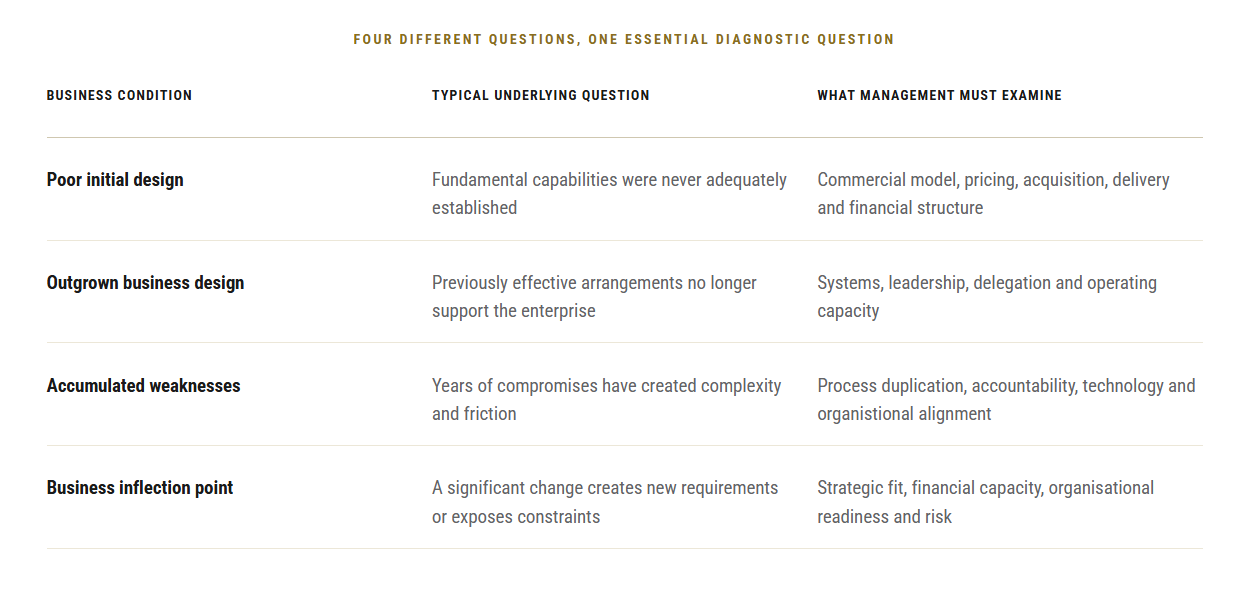
A business does not need to have enjoyed substantial success before it encounters a Growth Ceiling. Some businesses are constrained by weaknesses embedded in their original design. Others outgrow arrangements that once worked exceptionally well. Still others accumulate structural weaknesses over time or encounter Business Inflection Points that demand a different response.
And critically, these constraints do not always reveal themselves through declining revenue.
A business can be growing rapidly while becoming less profitable, more complicated, more dependent on its founder, less capable of supporting its next stage of development and more fragile.
Which leads to a question that challenges one of the most common measures of business success:
Is your business actually becoming more scalable, or is it simply becoming bigger?
The short version
A bigger business is not necessarily a better-designed business.
Growth can increase revenue, headcount and market presence without improving profitability, productive capacity or organisational independence.
Some businesses struggle because their original design was inadequate. Others become constrained because they have outgrown a previously successful model. Significant opportunities, threats and transitions can also expose the need for a different design.
The practical implication: Before pursuing more growth, determine whether the business has the capabilities required to accommodate it productively.
The Dangerous Assumption That Growth and Scale Are the Same Thing
Growth measures how much bigger the business has become. Scalability measures how effectively the business can accommodate becoming bigger.
It's this distinction that changes how growth should be evaluated.
This distinction becomes particularly important when a business encounters constraints that additional growth activity cannot resolve. Because if the operating model is fundamentally unsuitable, increasing the volume of activity flowing through it may simply magnify its weaknesses.
Growth Ceilings Are Not Always the Consequence of Success
The conventional explanation for a Growth Ceiling is relatively straightforward.
A business grows successfully, eventually reaches the limits of its existing systems and must change to accommodate its next stage of expansion.
This certainly happens. But it is only part of the picture.
Within the Growth Authority Philosophy, a Growth Ceiling is a structural, strategic, commercial, organisational or financial limitation that prevents an enterprise from achieving its desired level of performance or progressing to its next stage of development.
It is not defined by a particular revenue threshold. Nor is it necessarily the consequence of previous success.
Understanding how these constraints develop is essential because different causes require different interventions.
1. When the Original Business Design Was Never Adequate
Some businesses encounter structural limitations almost from the beginning.
An advisory practice may possess exceptional technical expertise but lack a reliable method of acquiring clients.
An engineering consultancy may generate strong demand but consistently underestimate the cost of delivering its engagements.
An IT services provider may build its entire commercial model around a small number of customers, creating a concentration risk that limits its strategic flexibility.
In each case, the owner may interpret disappointing performance as a need for more sales, more employees or greater effort.
But the underlying constraint may exist within the original design of the enterprise.
If pricing is inadequate, increasing sales volume may generate additional work without producing satisfactory returns.
If client acquisition depends entirely on the founder's personal relationships, recruiting additional delivery staff will not necessarily create a sustainable revenue engine. If the business lacks effective financial controls, rapid expansion may intensify working-capital pressures.
The challenge is not that the business has outgrown a successful model. It is that important elements of the model may never have been properly established.
2. When a Previously Successful Business Outgrows Its Design
Other businesses encounter constraints precisely because they have been successful.
A founder-led sales model may work exceptionally well when the business serves twenty clients. It may become increasingly difficult to sustain when the client base expands to two hundred.
Informal decision-making can be highly effective within a small team. As the organisation grows, those same arrangements may create confusion, inconsistent execution and excessive dependence on a handful of individuals.
Highly customised service delivery may initially establish a competitive advantage but eventually create operating complexity that becomes difficult to manage profitably.
The problem is not necessarily that the original decisions were poor. They may have been entirely appropriate for the business at the time. The problem is that the business has changed while its underlying design has not.
3. When Accumulated Compromises Create Structural Weakness
A third source of Growth Ceilings is more gradual.
Over time, businesses accumulate exceptions, workarounds and compromises.
A temporary approval process becomes permanent. A client-specific delivery arrangement becomes an informal operating standard. Different teams adopt incompatible systems. Responsibilities become fragmented.
None of these decisions may appear particularly consequential in isolation. But collectively, they can produce an organisation that becomes increasingly difficult and expensive to operate. Eventually, the business is carrying an accumulation of complexity that limits its ability to respond effectively to new opportunities.
4. When a Business Inflection Point Changes What the Enterprise Must Be Capable of Doing
A Business Inflection Point is distinct from a Growth Ceiling.
It is a significant opportunity, threat, disruption or transition that materially changes the decisions facing an enterprise.
It may expose an existing Growth Ceiling, create new operating requirements or make a previously effective business model unsuitable.
Consider an established professional services firm that wins an opportunity to deliver a major national contract. The opportunity could transform its revenue. But it may also require capabilities the organisation does not currently possess: stronger project governance, additional working capital, geographically distributed delivery, more sophisticated management reporting and a different leadership structure.
Alternatively, a firm may lose a major client, encounter a technological disruption or face a significant ownership transition.
The immediate circumstances are different, but the strategic question is similar.
Can the enterprise's existing design accommodate the new conditions without undermining its economics, service quality or resilience?
A positive inflection point can be just as demanding as a negative one.
An acquisition, major contract or geographic expansion can create significant value. It can also introduce complexity and financial exposure that the existing organisation is poorly equipped to manage.
The significance of this distinction is profound.
Two business owners can experience the same symptom and require completely different responses.
Both may be struggling to grow. One needs to establish a viable commercial model. The other needs to redesign a successful model that has reached the limits of its current capacity. A third may need to adapt to a fundamental change in market conditions. Applying the same growth strategy to all three would ignore the underlying cause.
The same symptom does not necessarily indicate the same problem. And the same growth strategy will not necessarily produce the same result.
Why diagnosis must come before prescription.
Why Adding More People Does Not Automatically Create More Capacity
For many professional, technical or expertise led service firms, recruiting additional professionals is the natural response to increasing demand.
An engineering consultancy hires more engineers. An accounting practice recruits additional accountants. An IT services business expands its technical team. There is nothing inherently wrong with this approach. Expertise-led businesses often require skilled human judgment, and hiring can be economically sensible when additional work generates an attractive return.
The problem emerges when leaders assume that adding people automatically increases the organisation's productive capacity by an equivalent amount.
Research supports the need to challenge this assumption. In a large-scale study of 58 open-source software projects involving more than 30,000 developers, researchers from ETH Zurich found that individual productivity tended to decline as team size increased, identifying growing coordination requirements as a contributing factor.[1]
While larger teams may generate greater total output, the research illustrates an important distinction: increasing the resources available to a business does not necessarily produce a proportionate increase in its productive capacity.
Every additional employee operates within an existing organisational system. Their effectiveness depends on how work is allocated, decisions are made and standards are maintained.
Without appropriate organisational design, additional recruitment can introduce new demands on existing resources through greater communication, supervision and coordination requirements, partially offsetting the productive benefits of expanding the workforce.
If those arrangements are inadequate, recruitment can increase coordination demands without resolving the underlying constraint.
Consider a consultancy where the founder personally approves every major proposal.
At ten consultants, that arrangement may be manageable. At forty, it may constrain responsiveness, profitability and client experience.
The workforce has expanded, but the capacity of the decision-making system has not.
Hiring more consultants will not resolve that problem. Redesigning decision authority might.
The same principle applies to a smaller firm that has never established consistent pricing or project acceptance criteria. Its problem is not necessarily insufficient resources. It may be the arrangements governing how those resources are used.
The productive capacity of a business depends not only on the resources it possesses, but on how those resources are organised, coordinated and deployed.
A foundational principle of Business Design.
The Hidden Cost of Growing Without Greater Capability
As service firms expand, coordination requirements often increase.
More employees require supervision. More clients create additional relationships. More complex engagements introduce further decisions, reviews and delivery requirements.
Some of this complexity is necessary. Effective governance and quality assurance protect clients and the enterprise. Other complexity reflects unclear accountability, duplicated processes and accumulated workarounds.
The distinction matters.
When management spends increasing amounts of time coordinating work rather than improving its delivery, the organisation may be accumulating operating friction faster than productive capability. This can occur in a struggling small firm, a successful business that has outgrown its systems or an enterprise responding to an acquisition or major contract.
The objective is not to eliminate management.
It is to ensure that management effort creates proportionate value.
When the effort required to manage growth increases as quickly as the growth itself, the business may be accumulating complexity faster than capability.
The hidden cost of expanding without redesigning.
Two IT Services Firms. Identical Growth. Different Economics
Consider two hypothetical IT services firms.
Both begin with $5 million in annual revenue. Both increase revenue to $7 million.
Firm A achieves this primarily through additional recruitment. Its delivery model remains highly customised, with senior specialists closely involved in scoping, supervision and problem-solving.
Firm B also recruits professionals, but has invested in reusable technical components, consistent project architecture, stronger documentation and processes and defined decision rights.
Its existing capabilities support a greater proportion of the additional work.
The financial consequences could be substantial.
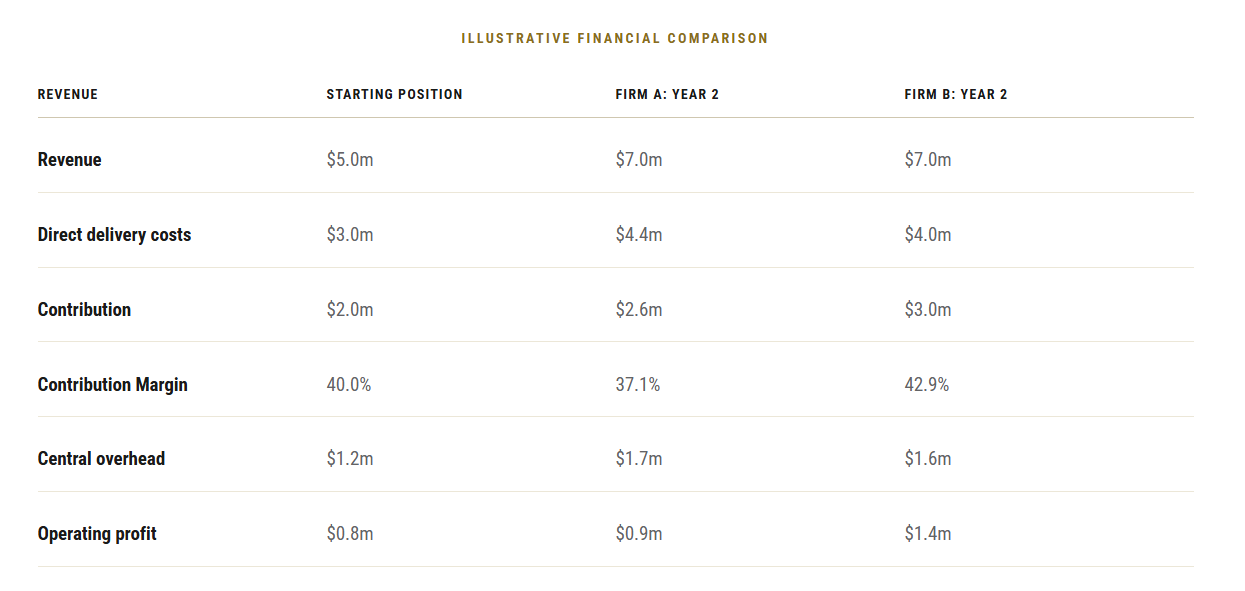
Both businesses achieve 40% revenue growth.
Firm A increases operating profit by $100,000.
Firm B increases it by $600,000.
The difference arises from the resources required to support the additional revenue.
Firm B demonstrates stronger operational leverage, although its historical investment costs, commercial risks and delivery quality would still need to be assessed before concluding that it creates superior overall value.
Now imagine both businesses encounter a major new contract requiring a substantial increase in capacity.
Firm A may need to recruit and coordinate an almost entirely new delivery team.
Firm B may be able to reuse existing systems while selectively expanding specialist capacity.
The opportunity is identical.
Their organisational readiness is not.
Same revenue growth. Different operating models. Different economic outcomes.
Why the quality of growth matters more than the headline number.
Operating Leverage Is Not Simply Cost Reduction
Operational leverage is often confused with reducing expenditure. But within the Growth Authority Philosophy, it describes the economic benefit of increasing productive output without requiring a proportionate increase in supporting resources.
A consultancy might develop reusable diagnostic methods. An engineering firm might reduce avoidable rework through standardised project components. An accounting practice might improve onboarding so professionals spend less time correcting incomplete information.
These improvements can increase productive capacity without eliminating the need for skilled people.
Indeed, greater leverage may initially require additional investment in technology, leadership, training or quality assurance. The appropriate intervention depends on the underlying constraint.
A business with poor initial design may need stronger commercial fundamentals. An established firm may need to redesign processes and delegation. A business confronting an inflection point may need entirely new capabilities.
The objective is not simply to spend less. It is to create more economic value from the resources committed to the enterprise.
The economic logic of Operational Leverage.
The Founder's Time Is Part of the Scalability Equation
Founder dependence is another frequently overlooked constraint.
Consider a consultancy whose revenue increases from $4 million to $8 million over three years.
During that period, the founder's working week increases from 45 to 65 hours.
The business has doubled in revenue, but may also have become more dependent on one individual.
That dependence can limit decision-making capacity, organisational resilience and the transferability of the enterprise. It can also distort profitability comparisons when substantial executive responsibilities are performed by an owner without an equivalent market-based compensation expense.
Not every founder should withdraw from operations. Their expertise, relationships and judgment may create exceptional value.
The distinction is between valuable founder involvement and unnecessary founder dependence.
A business that grows only because its founder works harder has increased its output. It has not necessarily increased its independent capacity.
The founder-dependency test.
Five Measures That Reveal Whether Your Business Is Becoming More Scalable
Revenue is important, but it cannot reveal the full economic or organisational consequences of growth.
Five measures provide a more useful assessment.
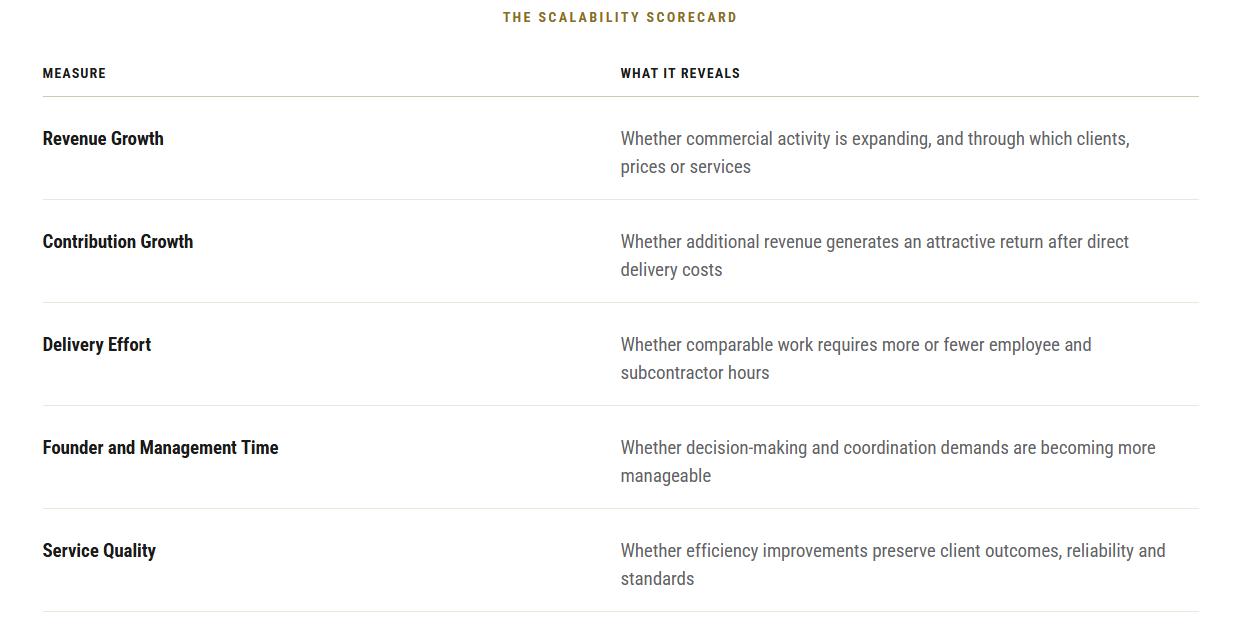
Revenue per employee can be misleading when work is transferred to subcontractors.
Improved margins may conceal excessive unpaid founder effort.
Higher utilisation may reduce the capacity needed for quality assurance, development or unexpected demand.
The objective is not to find one perfect productivity ratio. It is to understand whether the business is becoming more capable of producing attractive outcomes as its demands increase.
Before You Commit to Another Phase of Growth
It's worthwhile considering these three questions.
1. What created the additional revenue, and what did it cost?
Separate pricing improvements, additional work and changes in client mix. Include delivery resources, subcontractors and management demands.
2. What capability has the business developed?
Can it now serve comparable clients more efficiently and consistently, or does each additional engagement require the same effort and intervention?
3. Is its current design appropriate for the next challenge?
For a struggling business, the priority may be correcting weaknesses present from the outset. For an established business, it may be replacing practices that no longer support its scale. For an enterprise facing an inflection point, it may be developing capabilities required by new market or operating conditions.
The purpose is not to achieve a perfect score. It is to identify where business design must change.
The Objective Is Not Simply A Bigger Business
There is nothing inherently wrong with building a larger, labour-intensive service firm.
Many excellent businesses expand through skilled recruitment, maintain attractive economics and deliver substantial client value.
The objective is not to eliminate human expertise or pursue automation for its own sake.
It is to ensure that growth creates an economically worthwhile result.
That requires understanding the relationship between the business's design, its current performance and the capabilities required for its future.
Some businesses must correct weaknesses that have existed since their establishment. Others must evolve beyond arrangements that previously supported their success. Still others must adapt to significant opportunities, threats or transitions.
The appropriate response will differ.
The governing principle does not.
Growth increases the size of a business. Better business design determines whether that growth also increases its productive capability.
The principle behind scalable growth.
This is why the Growth Authority Philosophy begins with the proposition that every business is perfectly designed to produce the results it is currently achieving. Not because every outcome is intentional or every external condition controllable. But because the enterprise's strategy, commercial model, operating systems, leadership and financial structure materially influence what it can achieve.
When those arrangements are inadequate, greater effort may not resolve the problem. When they become unsuitable, previous success offers no guarantee of continued performance. And when circumstances change, even a well-performing enterprise may need to evolve.
The challenge is not simply to grow. It is to design a business capable of producing the results its owner is seeking.
Because a business can become larger, busier and more complex while simultaneously becoming less economically attractive. And that raises the next question in the Growth Authority series:
What happens when revenue is growing, but the underlying business is becoming weaker?
That is the subject of our next article: Why Revenue Growth Can Conceal a Weaker Business.
Continue Developing Your Growth Authority
Building a scalable service business requires more than pursuing additional revenue.
It requires understanding the relationship between commercial demand, operational capability and the economics of growth.
The Halcyon Strategy Brief explores these relationships through practical, evidence-informed analysis for business owners seeking to overcome Growth Ceilings, navigate Business Inflection Points and build stronger, more valuable enterprises.
Follow the Growth Authority series and receive practical analysis on building a more scalable, resilient and valuable service business.
Designed to Attract. Designed to Scale. Designed to Compound.
Joel Hewish
Partner - Strategy, Growth & Transactions
Halcyon Strategy Partners
References
[1] Scholtes, I., Mavrodiev, P. & Schweitzer, F. (2016). From Aristotle to Ringelmann: A Large-Scale Analysis of Team Productivity and Coordination in Open Source Software Projects. Empirical Software Engineering, 21, 642–683. https://doi.org/10.1007/s10664-015-9406-4
THE HALCYON STRATEGY BRIEF
Your Next Great Idea Is Waiting.
The most valuable insights are often the ones you weren't looking for.
Get a fresh perspective on business, growth and competitive advantage delivered to your inbox every Monday, Wednesday and Friday morning.
15 MINUTES. ONCE A WEEK. ONE IDEA WORTH THINKING ABOUT.
Your Next Great Idea Is Waiting
The most valuable insights are often the ones you weren't looking for.
A sharper way to think about your business.
THE LATEST THINKING
Ideas Worth Your Attention
Some of the biggest opportunities in business begin with a question nobody else is asking. Explore the ideas, strategies and overlooked advantages that could change how you grow, lead and compete.



Ready To Fix Your Most Urgent Business Problems?
No-cost, 60-minute executive diagnostic. We'll prioritize the highest-return actions and show you exactly what to do next.

Innovation
Fresh, creative solutions.

Integrity
Honesty and transparency.

Excellence
Elite outcomes.


FOLLOW US

COMPANY
CUSTOMER CARE
LEGAL
Copyright 2026. Halcyon Strategy Partners. All Rights Reserved.