
Your Business Is Designed to Produce Its Current Results
Why familiar problems keep returning—and how changing the way work gets done can change the results.
By Joel Hewish · December 7, 2026 · 15 min read
GROWTH AUTHORITY
The same problem has returned. Again.
You have discussed it in meetings, hired capable people and made it very clear that it needs fixing. Everyone agrees. Everyone gets busy. Three months later, there it is.
Perhaps clients still wait too long. Perhaps revenue is still inconsistent, lumpy and hard to predict. Perhaps cash remains stubbornly tight. Perhaps your managers have more impressive titles, but you have to keep solving their problems.
Eventually, another request to “take ownership” starts to sound less like leadership and more like pulling teeth. If any of this sounds familiar, there is a question worth asking before the next meeting:
What if the business keeps producing these results because of the way it is designed?
I encountered that problem as CEO and Chief Investment Officer of United Global Capital, when we were establishing self-managed superannuation funds (a special type of retirement account available in Australia) at volume. We would work through one bottleneck, only to find the work getting stuck somewhere else.
That experience gives me a practical reason to care about a distinction every service business eventually faces: the difference between putting more effort into the work and changing how the work actually gets done.
The short version
A recurring problem is rarely a failure of effort. It is usually a result of how the business is arranged: who can act, what information they receive and where work waits.
This article follows one such problem through a growing retirement-services business, then asks what the management research says about changing the arrangement rather than the person.
The practical move: pick one recurring result, trace what produces it, and change the design, and test.
A retirement business problem with a much wider lesson
For readers outside Australia, a self-managed superannuation fund, or SMSF, is a special type of retirement fund which allows members enormous flexibility to invest in a range of investments not typically available through traditional retirement accounts. Essentially the members take responsibility for running it, even when professionals help them.
The useful connection is the service-delivery challenge. Advisers may win a client relationship, but substantial work can remain before the client's arrangements are established and the intended service is delivered.
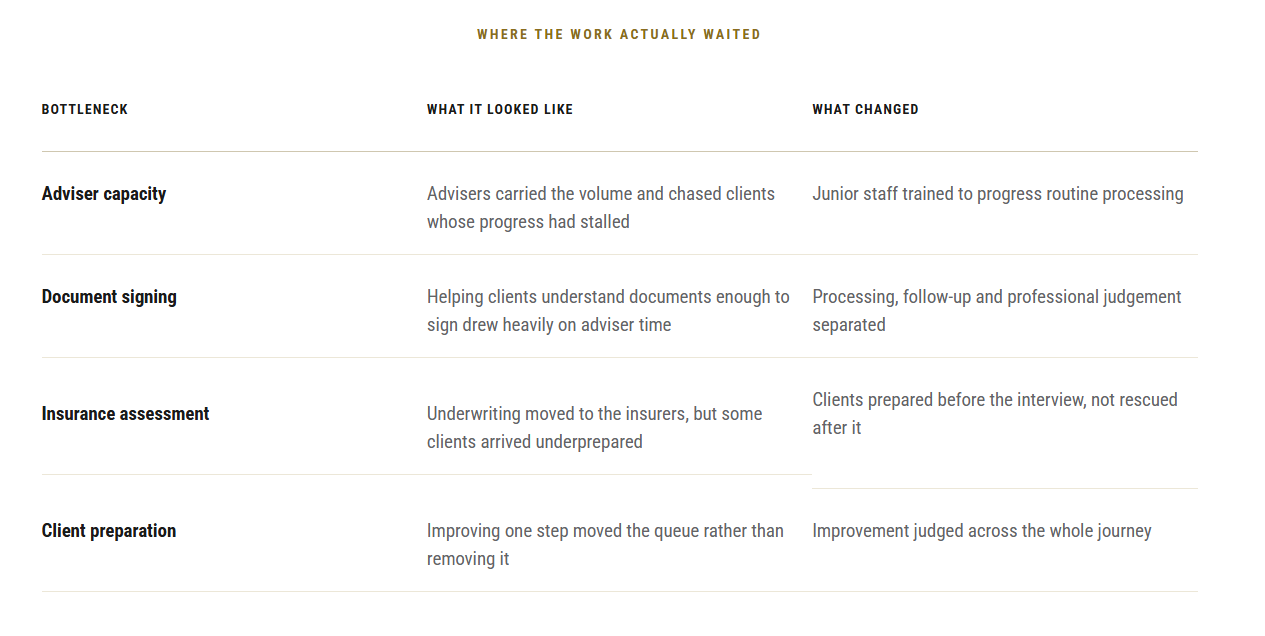
At my former firm United Global Capital (UGC), the work initially got stuck around the advisers. They had to handle the volume and follow up clients whose progress had stalled. Some clients needed intervention before anything else could move forward. Those cases competed for the advisers' time alongside their other responsibilities.
As we worked through that constraint, document signing became another. Sending documents was one task. Helping clients understand the documents well enough to sign them was another, and that drew more heavily on adviser time. The paperwork could leave our office without the client moving much closer to completion.
Then the insurance assessment process became a constraint. We shifted the underwriting work to the insurance companies through tele-underwriting, with clients completing the underwriting interview over the phone. That helped address one problem and exposed another: some clients were underprepared for the call. Our advisers could typically help overcome that, but their involvement was yet again still needed.
Outsourcing a step did not remove the need to prepare the person undertaking it.
There was no single fix that made every delay disappear. The bottleneck moved as we improved different parts of the process.
The breakthrough was changing what needed an adviser
One of the most useful changes was training more junior staff to take on processing work that had previously required heavy adviser involvement. We also trained them to take a more active role in resolving routine problems and keeping clients moving. Their role became more useful than simply passing a stalled case back to an adviser.
That reduced the need for advisers to be involved until a genuinely consequential issue required their attention.The distinction mattered.
A problem can be urgent to the person waiting without requiring the firm's most experienced professional to handle every part of it. Processing work, follow-up and professional judgement place different demands on people's skills. If the business routes all of them through the same scarce people, their expertise becomes difficult to access precisely when it matters most.
Our experience was that turnaround times improved. We shortened the time to close engagements and complete retirement-account rollovers and got insurance cover in place sooner. The changes improved profitability, cash flow and made us more attractive to referrers and that resulted in them sending more business our way.
We changed who could progress the work, what they were equipped to handle and when an adviser needed to step in. We also learned that handing work to an outside provider might solve one problem and create an entirely new problem for us to solve.
That is business design in practice. It reaches beyond a process chart into people's capabilities, responsibilities and the experience of the client trying to get through it all.
Your client experiences the whole journey
The UGC experience illustrates a problem that appears in many expertise-led firms: winning the work and completing the work require different capabilities.
A sales report can show progress while unfinished client work accumulates elsewhere. Everyone involved may be busy but the client may still be waiting.
That is why “we need everyone to work faster” is such an incomplete diagnosis. Faster at which stage? Waiting for what? And does the next person have what they need to act?
It is also why an improvement should be judged across the whole journey. Moving work out of one person's queue achieves little if it simply bottlenecks with another person.
For a retirement client, that journey concerns something deeply personal. For a legal client, it may concern a dispute or a transaction. For an engineering client, a project cannot proceed without the completed works, delays represent additional holding costs and potential penalties.
The internal explanation that “our part is finished” offers limited comfort to a client or customer still waiting for the final result.
Your client does not experience departmental productivity. Your client experiences the time and quality of the whole journey.
WHAT THE CLIENT ACTUALLY EXPERIENCES
Your business may contain several businesses you have outgrown
Early in a business' life, having the founder answer every difficult question can be sensible. The founder knows the clients, understands the work and makes decisions quickly. Later, the same arrangement can leave a much larger team waiting for one person.
A client exception becomes a standard promise. A temporary spreadsheet becomes essential infrastructure. An informal handover survives because an experienced employee knows what everyone else has forgotten. Nobody holds a strategy meeting to approve these arrangements. They accumulate.
This is what I mean by accidental design. Your business has a way of operating, even if nobody deliberately chose it as a complete system.
It includes the clients you accept, the prices and promises you make, the information your team receives, the decisions people can make and the point at which you get paid.
These choices interact. A promise made in sales becomes a delivery obligation. A delivery delay becomes a client-service problem. If invoicing depends on completion, that delay can become a cash problem too. By the time the owner notices the bank balance, the relevant issue may be several departments away.
This sits at the foundation of Halcyon's Growth Authority Philosophy.
Every business is perfectly designed to produce the results it is currently achieving.
The premise behind Growth Authority
You cannot control everything that happens
A market can turn. A major client can fail. A key employee can leave at precisely the wrong moment. Sound decisions do not make a business immune to bad outcomes. “Perfectly designed” does not mean every result was intended, deserved or preventable. It means that business design influences what is likely to happen when that event occurs. It impacts how severely it is affected and whether a problem keeps returning.
For example, an owner may have no control over a customer's insolvency but how much of the business' revenue depends on that customer, how much remains unpaid and how much cash the business holds will influence the damage, and that is often a function of business design.
The useful response examines both the event and the exposure.
The same discipline applies to bottlenecks. A delayed file does not prove the whole process is broken. Repeated delays at the same handover give you somewhere specific to investigate.
You need evidence of what is happening, otherwise “business design” becomes an impressive way of saying that things should have been different.
Does changing management actually change performance?
There is strong research behind taking management practices seriously, although it deserves a more careful reading than a motivational headline usually allows.
What does “better management” actually mean? A more charismatic CEO? Another strategy retreat? A dashboard nobody opens?
The research behind this question is considerably more practical.
In their 2007 study of 732 manufacturing firms, Nicholas Bloom and John Van Reenen [1] scored 18 management practices across four areas:
Operations: how firms improved production processes and responded to recurring problems.
Monitoring: whether performance was tracked, discussed and followed by action.
Targets: whether objectives were clear, appropriately demanding and connected across the organisation.
Incentives: how firms developed, rewarded and promoted strong performers, and addressed underperformance.
The interviews sought concrete examples. Managers were unaware they were being scored, and interviewers did not know the firms' financial performance beforehand.
One revealing distinction concerned recurring problems. Low scores reflected little improvement when something went wrong. At the highest level, identifying and resolving problems was embedded in everyday responsibilities.
The results showed that stronger overall scores were associated with better business performance.
For an owner, that raises an uncomfortable question:
When your team solves a problem, does the business learn, or does it simply get through another day?
Consider a missing client document. Someone chases it, the file moves, and everyone returns to work. But if the same omission delays the next twenty clients, the immediate rescue has left the underlying problem intact.
In my experience, effective management needs to do two jobs: resolve today's interruption and reduce the likelihood of tomorrow's repetition.
A later experiment made the economic consequences more tangible.
In Indian textile plants, Bloom and colleagues tested an intervention covering 38 operational practices [2].
Treatment plants received a month of diagnosis followed by four months of implementation support; control plants received the initial diagnosis only.
One example involved fabric defects. Recording and classifying faults helped managers identify their sources and address them in daily quality meetings. Previously, a faulty loom could keep producing errors for weeks.
The researchers reported a roughly 43% reduction in the quality-defect index and estimated a 17% productivity improvement in the first year. They also found evidence consistent with better information enabling owners to delegate more decisions.
Some owners had previously believed additional quality controls were unnecessary because their businesses were profitable and comparable with local competitors. The authors identified information barriers as a likely explanation for non-adoption.
In a professional and technical services firms, comparable weaknesses might appear as repeated client chasing, avoidable rework or routine decisions waiting for a senior professional.
Everyone is busy. Clients eventually receive their work. Revenue arrives. But the cost of the arrangement can remain hidden inside the effort required to keep it functioning.
That is the connection I draw to our SMSF establishment experience at United Global Capital.
Training support staff to progress routine issues changed which work required an adviser's attention. As the bottleneck moved from adviser capacity to document signing, underwriting and client preparation, we had to keep changing how the work progressed.
An instruction to “follow up faster” would have left the same advisers carrying the same dependencies.
The more useful question was: what needs to change so this work can progress reliably, with the right person involved at the right moment?
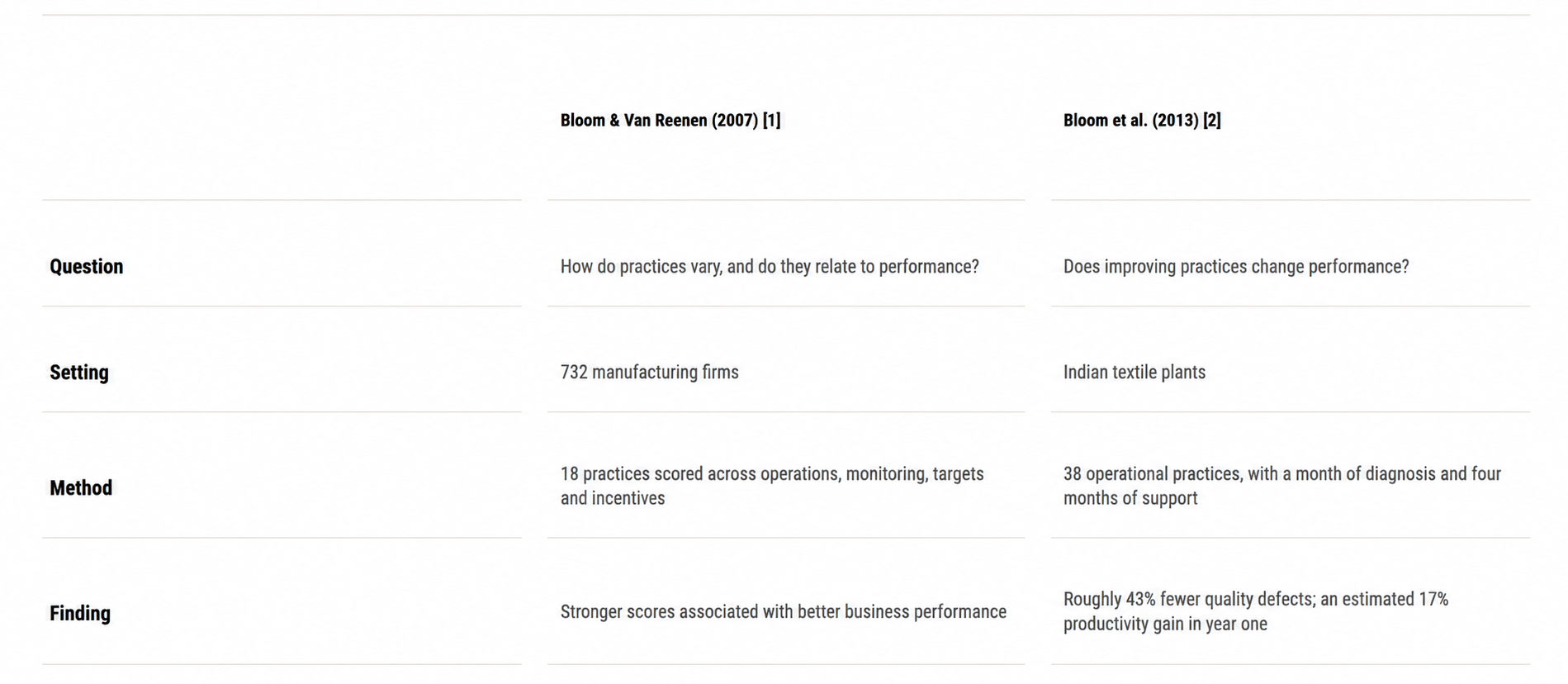
Neither study establishes what caused the improvement, and neither validates the Growth Authority Philosophy as a complete system. The research supports taking the organisation of work seriously; your own business still needs its own diagnosis.
A profitable business can still contain expensive weaknesses that everyone has learned to live with.
Beware of the business that works because you keep rescuing it
Professional and technical service firms can conceal weaknesses for a remarkably long time.
A senior specialist stays late. The founder handles the difficult call. Someone remembers to chase the missing document before the client notices. The work gets finished. The financial report records the revenue. The rescue effort may disappear into everyone's evening.
If you only measure what was delivered, you can miss what it took to deliver it.
This matters for an owner trying to build a business of lasting value. A firm that depends on exceptional people repeatedly compensating for unreliable arrangements carries a different burden from one that can deliver dependably through its normal way of working.
The answer is not to remove professional judgement or bury every decision in procedure. Some work requires discretion. Some checks should never be rushed. But, just blindly adding another management layer can simply create another place for work to wait.
Good design gives people the information, authority, capacity and safeguards their work actually requires to get done efficiently and effectively.
It also gives the owner a more revealing question than “How much did we sell?”
We can ask "What did the business have to go through to deliver it?"
Where Growth Authority takes this thinking
The lesson I draw from experiencing bottlenecks in a growing professional service business is that an operating problem deserves attention across the business. Treating every delay as an isolated task can leave the connections untouched.
That broader view is central to the Growth Authority Philosophy, Halcyon's integrated methodology for connecting business diagnosis with strategic, commercial, operational and financial decisions.
The aim is to identify Growth Ceilings and recognise Business Inflection Points where the design needs to evolve.
You do not need to memorise that architecture today. This series will unpack it. The starting discipline is to follow a recurring result across the business until you understand what helps produce it.
Before you ask everyone to try harder
Choose one problem that keeps returning. Be specific enough that someone else within the business can recognise it. “Our onboarding is poor” is difficult to investigate. Instead, “Eight of our last twelve clients waited more than six weeks to complete onboarding” gives you a starting point.
Then ask five questions.
Your 10-minute business design check.
Where does the work actually wait? Look at elapsed time between steps, including time when nobody is actively working on it.
What keeps it there? Missing information, limited specialist capacity, unclear authority and outside dependencies need different responses.
What evidence would challenge your explanation? If the suspected review stage has no queue, keep looking.
What change could you test without weakening quality or necessary controls? Make the change specific enough to see whether it affects the suspected cause.
Did the whole result improve? Track completion, quality and relevant costs. Check whether the change simply moved the queue somewhere else.
You may discover a staffing need. But you may discover that capable staff have been waiting for decisions, information or permission that the business has never learned to provide reliably.
Either finding is more useful than another general appeal for effort.
A recurring problem deserves more than a recurring meeting. It deserves an explanation you can test and a change you can evaluate. And this applies as much to marketing and sales as it does to business operations and leadership.
That leads to the next question in this series: as your business grows, is it becoming more capable of delivering, or is there simply more business for you to hold together?
In Article 2, we will examine the difference between growth and scale.
Subscribe to the Halcyon Strategy Brief to follow the Growth Authority series and receive practical analysis on building a more scalable, resilient and valuable service business.
Joel Hewish
Partner - Strategy, Growth & Transactions
Halcyon Strategy Partners
References
1. Bloom, N. and Van Reenen, J. (2007). Measuring and Explaining Management Practices Across Firms and Countries. The Quarterly Journal of Economics, 122(4), 1351-1408.
2. Bloom, N., Eifert, B., Mahajan, A., McKenzie, D. and Roberts, J. (2013). Does Management Matter? Evidence from India. The Quarterly Journal of Economics, 128(1), 1-51.
THE HALCYON STRATEGY BRIEF
Your Next Great Idea Is Waiting.
The most valuable insights are often the ones you weren't looking for.
Get a fresh perspective on business, growth and competitive advantage delivered to your inbox every Monday and Thursday morning.
8-10 MINUTES. TWICE A WEEK. ONE IDEA WORTH THINKING ABOUT.
Your Next Great Idea Is Waiting
The most valuable insights are often the ones you weren't looking for.
A sharper way to think about your business.
THE LATEST THINKING
Ideas Worth Your Attention
Some of the biggest opportunities in business begin with a question nobody else is asking. Explore the ideas, strategies and overlooked advantages that could change how you grow, lead and compete.



Ready To Fix Your Most Urgent Business Problems?
No-cost, 60-minute executive diagnostic. We'll prioritize the highest-return actions and show you exactly what to do next.

Innovation
Fresh, creative solutions.

Integrity
Honesty and transparency.

Excellence
Elite outcomes.


FOLLOW US

COMPANY
CUSTOMER CARE
LEGAL
Copyright 2026. Halcyon Strategy Partners. All Rights Reserved.